Recent Posts
By James Perry Days after Hurricane Katrina swept ashore in 2005, the federal levees failed, filling New Orleans with water. The combination of the near miss of the Hurricane and the levee collapse proved to be one of the greatest disasters ever faced by a metropolis. Katrina’s wrath decimated nearly 200,000 units of housing in […]
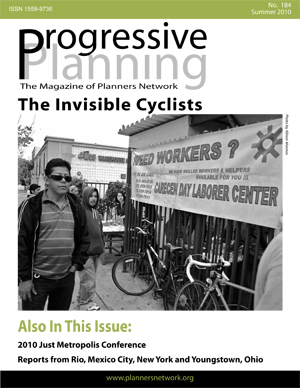
The Seventh Generation Beyond Networking, Left Alternatives by Tom Angotti Feature Articles The Invisible Cyclists of Los Angeles by Omari Fuller and Edgar Beltran The 2016 Olympics in Rio: A Community Plays Against the Real Estate Game by Theresa Williamson Mexico City Creates Charter for the Right to the City by Jill Wigle and lorena […]
By Jill Wigle and Lorena Zárate A new collective tool for social mobilization and democratic planning has been established in Mexico City. On July 13, 2010 Mayor Marcelo Ebrard of the Federal District of Mexico signed the Mexico City Charter for the Right to the City. In a recent article in the New Left Review, Emir Sader […]
By Theresa Williamson When Rio de Janeiro won the bid for the 2016 Olympics in 2009, only cries of approval were heard from Brazilians. The government threw a huge party on Copacabana beach, in Brazil’s densest neighborhood. According to Luiz Inacio Lula da Silva, the popular Brazilian president and leader of the Brazilian Workers Party, […]
By Omari Fuller and Edgar Beltran Night has fallen and you’re driving through a gritty urban center when you approach an intersection. Just as you turn right through the crosswalk a dark figure materializes before you. You slam on the brakes and stop just a foot or two away. Without pausing to acknowledge the near […]
By Tom Angotti Shortly after the Towards a Just Metropolis conference in the Bay Area, the U.S. Social Forum convened in Detroit. Between June 22 and 26 some 20,000 people got together there, nearly doubling the attendance at the first forum in Atlanta in 2007. While architects, planners, and community activists seriously networked at the Bay Area […]
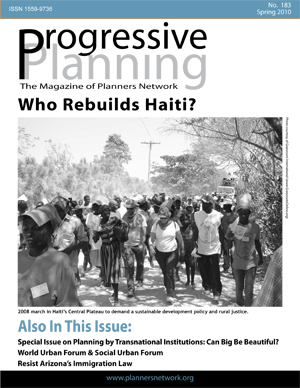
The Seventh Generation Haiti’s Fault Lines: Made in the U.S.A. by Marie Kennedy and Chris Tilly Planning by Transnational Institutions: Can Big Be Beautiful? Planning by Transnational Institutions: Can Big Be Beautiful? by Clara Irazábal Feeding Dependency, Starving Democracy…Still by Nikhil Aziz From Reaction to Proaction: Expanding the Scope of the CEDAW Committee’s Influence by […]
By Richard Platkin The Los Angeles Times (March 1 and March 14, 2010), Southern California’s rapidly shrinking, former newspaper of record, repeatedly complains that Los Angeles’s elected officials, primarily Mayor Antonio Villaraigosa and the fifteen members of the Los Angeles City Council, do not have a plan to guide them in their massive, highly selective cutbacks in municipal services, […]
By Aaron McKeon Last September, Time began a year of coverage of Detroit. Judging by the coverage in the September issue and subsequent installations online, the magazine’s angle is to present the nation’s eleventh largest city as all but a lost cause. Naturally, there is a lot of heart and guts in the city and plenty of determined people working for its survival, but Time seems to […]
By Peter Marcuse Two major world forums focused on urban issues—the U.N.-sponsored World Urban Forum (WUF) and a social-movement-sponsored Social Urban Forum (SUF)—took place in Rio de Janiero in the last week of March, 2010. The forums were extremely different, almost existing in two different worlds, but they tolerated each other; the contrasts and similarities were striking. In its own words, the World Urban Forum …was established by the United […]
About Progressive City
Progressive City: Radical Alternatives is an online publication dedicated to ideas and practices that advance racial, economic, and social justice in cities. We feature stories on inclusive urban planning practices, grassroots organizing, and civic action. Our contributors and readers are activists, reporters, practitioners, academics, and community members. Learn more about Progressive City and learn how to submit articles..
Follow us on social media:


Recent Comments