Recent Posts
By Gary Fields In 1989, the Berlin Wall fell and soon after that South African apartheid crumbled. At the time it appeared that such systems, with their landscapes of walls and practices of separation, would be consigned to historical memory. Today, however, there is a new generation of fear-driven landscapes, ranging from urban-based, gated communities […]
By Marilena Liguori On November 8, 2001 and in the wake of 9/11, President George W. Bush called on all Americans “to serve by bettering our communities and, thereby, defy and defeat the terrorists.” During the State of the Union address on January 29, 2002, he once again asked all Americans to commit at least […]
By Matt Hidek Since the 9/11 terrorist attacks, the United States government has developed defensive strategies to protect its cities through a complex web of networked security initiatives. As part of the “Global War on Terror,” the Department of Homeland Security (DHS) has partnered with state and local law enforcement agencies to deploy military-based intelligence […]
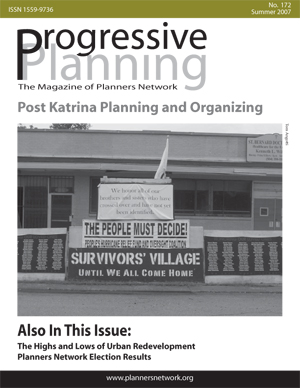
Grassroots Disaster Recovery Planning: New Orleans and Beyond Jason Neville and Clara Irazábal Social Justice in New Orleans: Planning after Katrina Peter Marcuse Transforming Top-Down to Bottom-Up Planning in Post-Katrina Mississippi Jennifer Evans-Cowley and Meghan Z. Gough Involving Students in Reconstructing New Orleans: An Example from Richmond Thad Williamson with Steve Horvath, Corrie Mixon and […]
By Kanishka Goonewardena The “real” planner must be a radical planner, planning for social justice and social change. In order to do this type of planning today, the hegemony of neoliberalism must be contested and defeated. What is neoliberalism? Neoliberalism is the dominant political-economic thought of our time–the philosophy of corporate globalization, which in turn […]
By Emily Achtenberg Visitors to La Paz in August 2004 experienced a rare event: a day without car horns, gasoline fumes and traffic congestion. A strike by transportation workers protesting an increase in gasoline prices sparked a series of road blockades, converting major downtown arteries into impromptu soccer fields and pedestrian-friendly boulevards. The streets soon […]
By David A. Turcotte The United States has almost 90 million residential structures. While few have been built in a sustainable manner, we are nevertheless beginning to see more interest in green or environmentally sustainable housing. Most discussions of sustainable housing focus on the environmental and economic aspects, overlooking the social dimension. Achieving sustainable housing […]
By Peter Marcuse This is intended by the author as a framework for discussion, and it should be stated at the outset that, if limits to what has been accomplished emerge, that is in no way a reflection on the quality of the effort, the integrity of the participants, or the solid contribution they have […]
By Jason Neville and Clara Irazábal Weeks have turned to months and months to years as New Orleanians—both those living in the city and those yet to return—have waited in vain for leadership and resources from local, state and federal sources. In the face of such neglect, and united with a determination to rebuild their […]
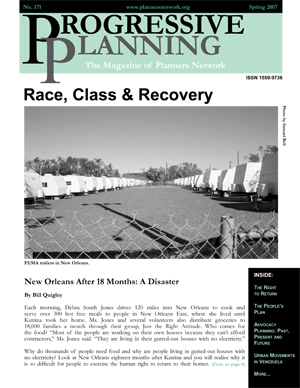
A View From the Barrios Sujatha Fernandes NEW ORLEANS: RACE, CLASS AND RECOVERY New Orleans After 18 Months: A Disaster Bill Quigley The Right to Return Anna Livia Brand The People’s Plan Kenneth M. Reardon ADVOCACY AND COMMUNITY PLANNING: PAST, PRESENT & FUTURE The Legacy Tom Angotti Transformative Community Planning Marie Kennedy Environmental Justice Romel […]
About Progressive City
Progressive City: Radical Alternatives is an online publication dedicated to ideas and practices that advance racial, economic, and social justice in cities. We feature stories on inclusive urban planning practices, grassroots organizing, and civic action. Our contributors and readers are activists, reporters, practitioners, academics, and community members. Learn more about Progressive City and learn how to submit articles..
Follow us on social media:


Recent Comments